Polymer Prodigy Labs

Modular Industrial Automation
Polymer Prodigy Labs Interconnected Lattice Identification Emblem Visual Verification & Structural Metrics Hub

Third-Party Material & Stress Validation

Empirical technical data is vital when substituting traditional milled alloys with custom engineering polymers. The following curated physical testing documentation provides transparent, destructive benchmarks comparing high-performance composite matrices against standard industrial metals under load configurations:

Comparative Material Specifications

While metal systems claim unmatched density caps, they frequently impose excessive over-engineering and extreme capital tool machining backlogs. Our Nylon-CF system captures required operational mechanical tolerances while eliminating supply dependencies.

Material Layer Density (g/cm³) Tensile Strength (MPa) Modulus of Elasticity (GPa) Relative Tooling Capital Cost
Engineering Nylon-CF (PPL Matrix) ~1.24 - 1.40 ~110 - 145 ~8.5 - 11.0 Minimal (Localized Desktop Printing)
6061-T6 Aluminum 2.70 310 68.9 High (External CNC Tooling Loops)
304 Stainless Steel 8.00 505 193.0 Extreme (Custom Machining / Casting)

The Infrastructure Journey: From Zero to Prototype

A transparent look at the timeline, development milestones, and physical validation blocks leading up to the Polymer Prodigy Labs launch:
Phase 1
Grit, Gear, and Grim Realities
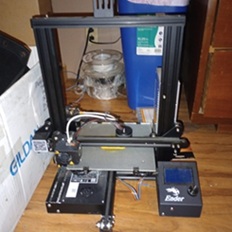
Polymer Prodigy Labs wasn't born in a corporate boardroom; it started on a bedroom floor. As a kid, Mark Martin was tearing down the family computer just to see how it ticked, eventually building his own rigs from parts ordered online back in the 90s and early 2000s. He wanted to pursue electronics engineering technology at ITT Tech, but higher education costs were horrendous. Growing up in a household where kids bought their own first cars, paid their own insurance, and bought their own gas at age 16, Mark understood exactly what $50,000 of debt meant at 18. Refusing a lifetime of unpayable student loans, he entered the manufacturing workforce at bottom-tier wages. To keep his sanity, he explored hobbies like woodworking—loving the construction phase but hating the tedious trim work. Then he discovered 3D printing. It wasn't about printing useless plastic toys; it was about functional purpose. Mark spent countless hours teaching himself 3D modeling, configuration management, and print orientation to force a basic $65 Ender 3 to churn out flawless, usable, real-world hardware.
Early 3D Printing Setup
Phase 2
The Neanderthal Bottleneck
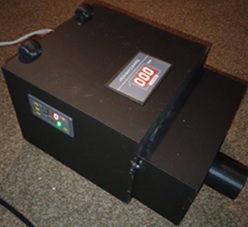
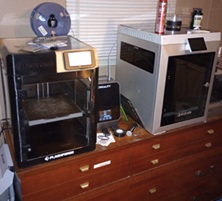
While working at Au**** *****ics and Be*** ***bal (now A***r), Mark mastered factory operations and process automation. But he also saw a massive disconnect. In an automated plant owned by a multi-billion-dollar corporation, operators were creating additive packets by scooping raw chemical ingredients out of a bag onto a scale like neanderthals. It was slow, outdated, and begged for automation. Mark built a primitive additive feeder prototype out of basic PLA plastic. At the time, he didn't even know different plastic variants existed; he was just having fun and pushing his own boundaries. When he migrated to a different position, he dropped the project altogether. However, a later promotion into Quality Control allowed him the time to spend on whatever he saw fit. Backed by better equipment, deeper material research, and vastly improved 3D modeling skills, Mark upgraded from his basic setup to a $140 enclosed Adventure 5M with a filament dryer, and eventually a $700 Qidi Q2C. These advancements on his equipment finally allowed him to print parts using rugged Nylon and Nylon Carbon Fiber (PA-CF) built to survive harsh, abrasive factory environments.
First Plastic Feeder Prototype
Phase 3
The 10,000-Line Disruptor
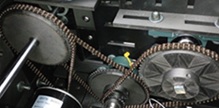
The original feeder prototype relied entirely on a manual timer, power percentages, and physical control knobs. It worked, but it looked outdated and skeptical for an industrial setting. To fix this, Mark bought an HMI screen and tried programming a standard PLC. It was a solid trial step, but the tiny screen became completely unreadable with more than five lines of data. This bottleneck forced a dive into software engineering. Leveraging modern AI to bridge the hardware-to-software gap, Mark transitioned to full Python programming. The mainstream media talks about data centers and AI like it's a magic button, but anyone who actually codes knows the truth: writing a 10,000-line functional industrial program is brutal work. It isn't just typing commands and hitting enter. It requires massive logic architecture, endless debugging, and deep sweat equity to manage hardware states. The result was a flawless, intelligent software engine running custom-printed Nylon Carbon Fiber mechanical assemblies.
Python Code and Final Assembly
Phase 4
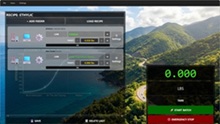
Hardware Optimization & Interface Upgrades
With the core mechanics and heavy software backend running successfully in isolation, I needed to address the physical operator interface. To completely eliminate the unreadable, tiny trial screens of the past, the system is being upgraded with a dedicated PC and a high-visibility, industrial touchscreen interface. This setup provides operators with clean data displays, responsive control loops, and professional system aesthetics. While the feeder hasn't been started up fully assembled quite yet, every individual sub-system, printed gear, and block of Python code has been systematically validated. Final software tweaks, sensor calibrations, and mechanical alignment testing are actively underway on the carbon fiber chassis to prepare the entire automated system for its highly anticipated live manufacturing debut.
Touchscreen and PC Hardware Upgrades
Phase 5
Commercial Scaling & On-Site Autonomy
The successful validation of the industrial additive feeder sparked the official launch of Polymer Prodigy Labs LLC. We are moving beyond a single device to solve a massive industry problem: hyper-inflated automation costs and rigid legacy equipment. Polymer Prodigy Labs specializes in bringing custom automated, 3D-printed manufacturing hardware to factory floors at a fraction of traditional capital expenditures. More importantly, we design with operational independence in mind. Every custom unit we deploy features a digitized design architecture, meaning that if an internal part or mounting bracket ever breaks down, the client can instantly reprint the exact commercial-grade replacement part right on their own factory floor. No waiting for weeks on overseas shipping, no proprietary markups, and no needless downtime. We build rugged, functional automation born from the factory floor, built with raw grit, and engineered for true self-reliance.
Polymer Prodigy Labs Commercial Launch